Modern documentation is becoming a deliverable service that’s an integral part of the product user experience. Documentation must work as a single source of truth for clients and internal teams. It must become a central point of knowledge – measured, controlled, and customizable by the respective teams' context.

The way users approach product documentation has changed dramatically in the last months. While docs are still consumed directly, more and more they’re served through AI-based filtering. Writers deploy AI-assisted workflows in authoring and content management. And yet, somehow, users still open support tickets 🙂.
Product documentation can no longer exist in a silo disconnected from customer support and AI workflows. This article explores why treating documentation as a "single source of truth" fails when teams use disjointed tools. By unifying content authoring, support feedback loops, and AI-ready context within the Atlassian ecosystem, organizations can stop simply publishing pages and start delivering true Knowledge as a Service.
Building Flawed Perfection
Those goals are impossible to achieve if documentation is developed in a silo or with tools that were never designed for authoring and managing content. Also, teams used to fight long internal battles over where to host documentation, what tools to use. Writers advocated for a dedicated documentation site. Support insisted on having docs where customers open tickets.
Results? Documentation that is perfect in a wrong way. Pages that describe what the code does rather than what users want to do, or doc sites built for the Support team’s convenience.
Case in point, if the Documentation CMS cannot even connect to Jira and the only connection between the Support site and documentation CMS is email a tech writer might read, it will be hard to find the common context denominator.

In other words, context is gone before it had a chance to form. As we noted what seems like forever ago, it’s garbage in, garbage out, now in 4K.
The solution certainly is not in throwing AI here, and installing an MCP (Model Context Protocol) server there. If you deploy AI over disjointed processes and doc sites that never served their primary goals, you’re only amplifying chaos. In theory, an MCP server acts as a great attractor – a bridge that connects AI agents directly to your data. But the problem is organizational silos amplified through tooling segregation, often boosted by the fact that teams were using wrong tools for the job.
Primacy of Documentation
Documentation’s raison d'être is to enable users to accomplish their goal while using the product. There are, of course, secondary causes, such as enabling product discovery and boosting general brand visibility.
Documentation also works as an anchor for Customer Support teams. So much so that some publish documentation to their Support portal. This is generally a bad idea. The moment you submerge documentation to the same environment where users come cry for help, you’re signaling surrender. You’re literally saying that the ability of users to browse their tickets is more important than their ability to use documentation and get help faster from the docs.
In this day and age, documentation must be your knowledge context. For writers, for support teams, for customers.
We’ve long advocated for using the right tool for the job. Docs writers need a content management system that works for them. Support needs a tool geared towards efficiency and efficacy. The problem in this day and age is that those tools must talk to each other all the time throughout the entire documentation life cycle.
In other words, everyone needs to be on the same page at any moment of the documentation lifecycle. This means making your product documentation the central point, treat it as the primary single source of knowledge to which everything else can connect.
Single Source of Truth - for Everyone
When looking for a practical way to build this documentation structure, the Atlassian suite of apps comes close to becoming a solution that ticks all the right boxes for product development, writers, content architects, support teams. Confluence is the content load-bearing structure that connects to Jira and Jira Service Management – all three apps are connected and you can treat them as three faces of the same tool. Rovo can connect everything to everything else.
But that might be a problem. Even with AI, or because of it, governance of that information richness is hard to achieve. As a user, you know that while you tweak your MCPs and agents and point them in the right direction, it’s hard to keep the context concise and free of noise. That requires filtering at every touchpoint.
What you need is a single place that you can be sure only has the verified, approved and published information. And that’s your official documentation.
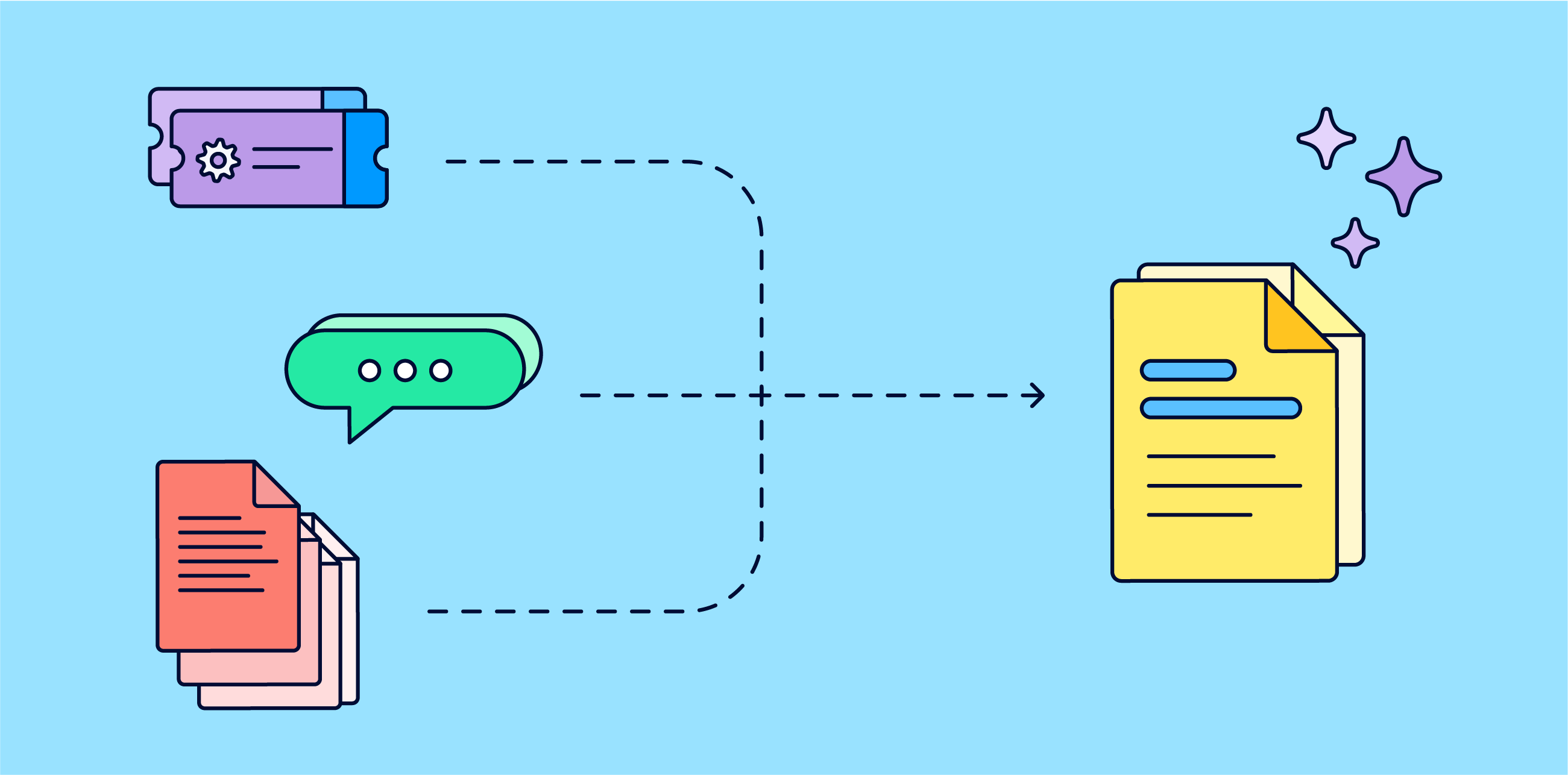
Your product documentation is the single asset that is only published when it’s ready and approved. And when you publish it to a dedicated resource that everyone can access, you’re establishing that single source of truth that is available to everyone at any given moment – customers, support, your sales team, your writers, your AI agents.
Alas, Atlassian apps focus mostly on internal company use cases, not on delivering documentation to your end users. But there are safe solutions. You need something that stands out independently but remains connected to the underlying Atlassian structure in the right way.
Scroll Sites is that tool that brings Confluence content to a public website – in its original form or tailored with Scroll Content Manager into release versions, product variants, or language editions.
Turning Documentation into Knowledge
By bringing documentation out into its dedicated portal, you’re ensuring that documentation fulfills its prime goals:
-
self-service
-
product description
-
feature discovery
-
SEO/AIO visibility
It becomes the approved benchmark both for your customers and your internal teams.
But information is a two way street. Users' interaction with information creates unique touchpoints that generate new knowledge: errors, omissions, bugs. Typically, when documentation portal is optimized for, well, documentation, you divert users to your Support portal. While that is still a much better option than hosting your docs in a support site, it may create a sense of disconnect and navigation chaos.
Scroll Support Hub solves this by exposing just the right facet of your support efforts to your users right in the Scroll Sites documentation portal. This solution preserves docs' primary roles while giving your customers access to open, review, and browse their tickets.
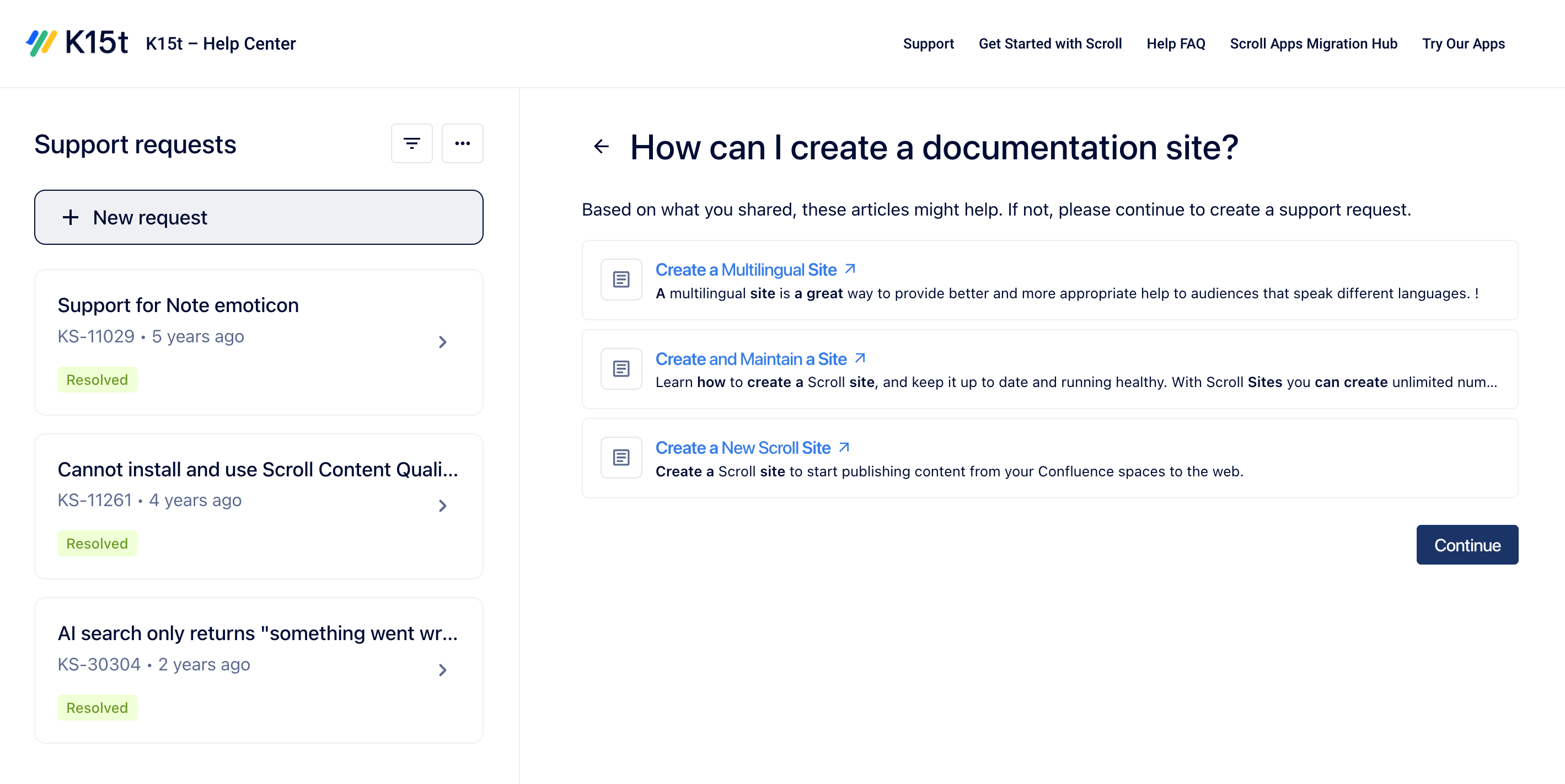
At this point, you no longer just publish documentation, you are delivering documentation as a service.
But the ticket itself becomes the knowledge – for you. User feedback tells you what worked and what did not, why the customers sought help, what they did, and so on. Scroll Support Hub captures that information and channels it back to your Jira, Jira Service Management, and Confluence triangle, where it merges into your existing documentation life cycle structure.
The crucial point is this newly acquired knowledge stays in the right context all the time.
Scroll Sites and Scroll Support Hub turn information into knowledge – both for you and your customers – and connect easily into your existing Atlassian infrastructure.
Delivering Knowledge as a Service
When documentation published via Scroll Sites becomes a central hub of your interaction with your customers, you’re already winning. With Scroll Support Hub you’ve established a knowledge loop that merges your customer feedback into your documentation life cycle. All under the auspices of the Atlassian infrastructure.
Corollary – you no longer have to brood over where to author, manage, and publish documentation.

But each customer interacts with your documentation differently. The use cases for a space telescope are wildly different from a social media management platform, and your users' contexts reflect that.
This is where Scroll Sites’s built-in MCP server changes the equation for both you and your users. For your organization, an embedded MCP server makes your product's knowledge instantly AI-ready. Your own internal AI agents – whether they are customer-facing support bots or internal sales assistants – can tap directly into your verified, published docs. You reduce the risk of AI hallucinating off outdated drafts because it is only consuming your official single source of truth.
The benefit extends outward, too.
Your customers can use that same MCP connectivity to pull your product documentation directly into their own environment – merging your docs with their daily workflows and the internal knowledge they've accumulated over the years.
You can take this a step further. True Documentation as a Service shouldn't feel like a disconnected, third-party vendor site. With Scroll Sites, you can build a unique, dedicated documentation portal for a specific customer that feels entirely native to a specific customer. By applying their custom domain, you remove the one-size-fits-all friction allow them to use MCP connectivity on their own custom site.
The context multiplier
With Scroll Sites, the Support Hub, and the embedded MCP server, you’re providing more than just pages of text. You are delivering:
-
Documentation as the verified single source of truth.
-
Direct, contextual access to support issues.
-
A feedback loop that channels user insights directly back into your docs.
-
AI-ready (MCP) connectivity tailored to the customer’s specific environment.
At this point, you’re well beyond publishing documentation or hosting a nice-looking support portal.
You are delivering knowledge as a service.