Fortune 100 Healthcare Aligns with an External Vendor Across Jira Without Shared Access
How a healthcare enterprise keeps an outside vendor in sync without exposing its data.
Background
Your external vendor can’t see your Jira, but the teams still need to communicate. This healthcare enterprise used Backbone Integration Platform to sync work automatically across isolated Jira instances, ensuring no shared access or data exposure.


 Transparency: Data ownership & visibility
 Governance: Sync selected data; no shared access
 Cost Efficiency: No extra Jira licenses needed for vendors


Jira users

live syncs with the external vendor

minutes to setup a new project sync
The customer in this story asked not to be named. Company and individual identifiers have been replaced with descriptors.
A financial technology group inside one of the largest U.S. healthcare services organizations needed to stay aligned with an external development vendor across two separate Jira instances. They had to keep their own workflows and access controls intact while ending the manual spreadsheet work that consumed hours every week.
The Challenge: Why Spreadsheets Failed
On the Atlassian admin side, the group is led by a Principal DevOps Architect who owns the Jira environment. The work moves across 15 internal teams and a third-party development vendor several time zones away. Naturally, neither side is permitted direct access to the other’s data.
Initially, the teams relied on spreadsheets and ran into predictable problems. “I had six people spending up to six hours a week just managing spreadsheets. It was constant chaos! ‘Where’s the latest version? Who locked it? Who’s on PTO?’ Every vendor update meant someone had to manually track it down, match it, and update our side by hand,” explained the DevOps Architect.
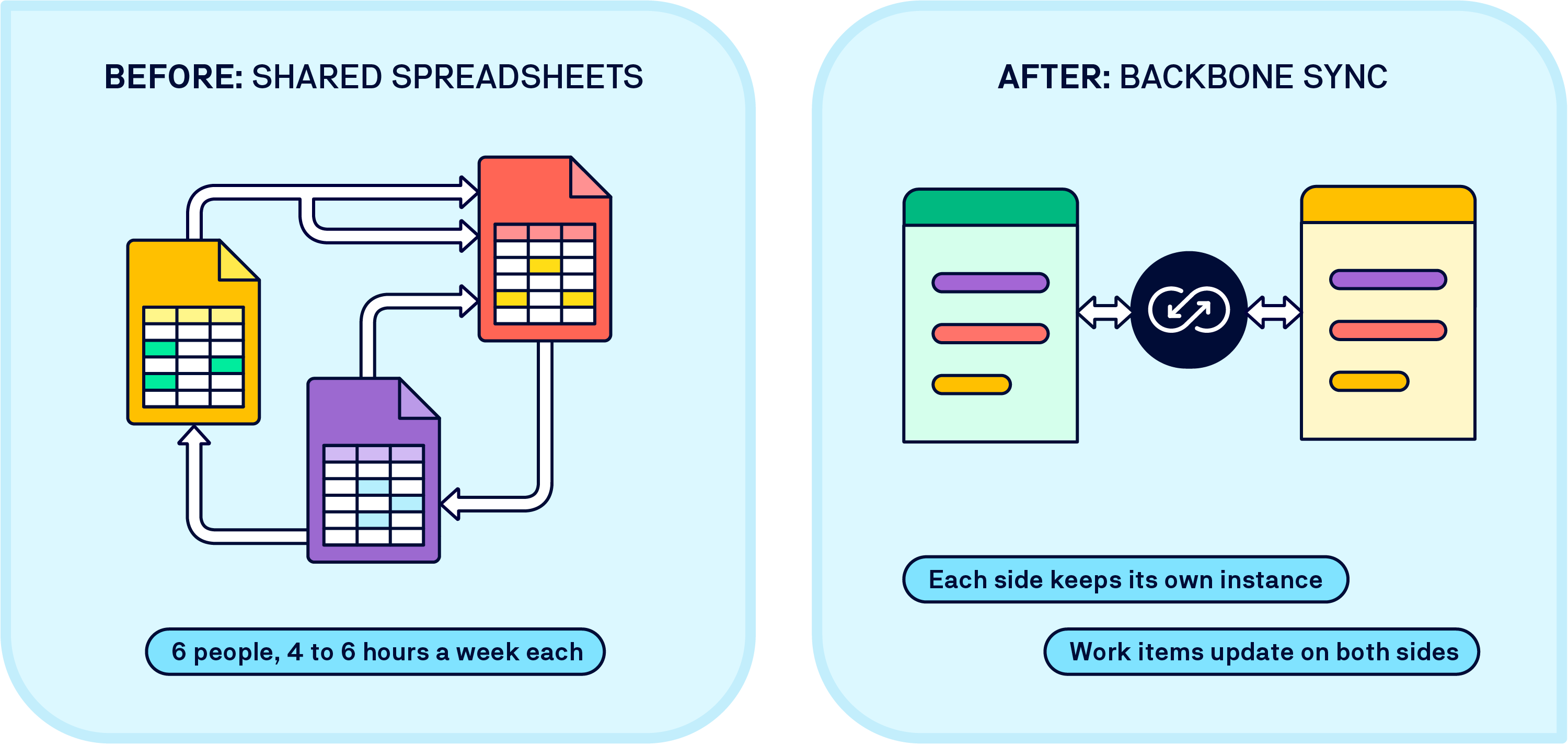
Spreadsheets simply couldn’t deliver the secure, autonomous collaboration required in a heavily regulated industry. Instead, Jira became the single source of truth, consolidating work from GitHub, Salesforce, and ServiceNow into one system of work.
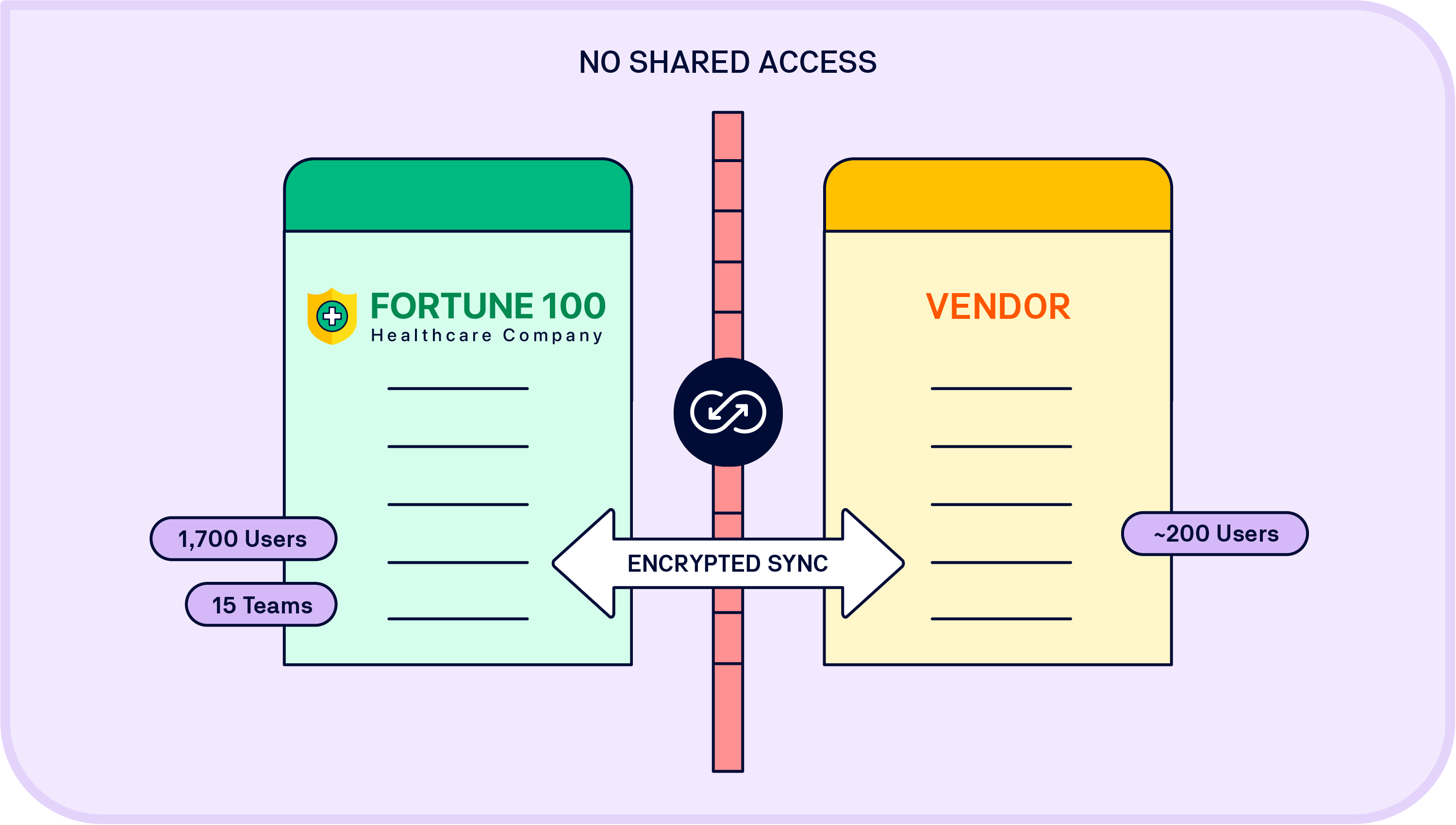
However, this created a new boundary to cross: the internal team managed a 1,700-user Jira instance while the vendor ran a separate 200-user instance. Direct access wasn’t an option, but both sides still needed seamless alignment on work items, sprint states, team assignments, and reporting.
Why the Fortune 100 Healthcare Enterprise Chose Backbone Integration Platform
That’s when the DevOps Architect and his team opted for Backbone to connect multiple spaces across two instances. They also evaluated Exalate, but found it unnecessarily complex and costly for their use case.
“Backbone was straightforward from the start. Our full stack is live, running smoothly, and backed by great support. Eliminating manual copy-pasting and human error is the real value. It has definitely paid for itself.”
Principal DevOps Architect
Fortune 100 Healthcare Enterprise
Enterprise-Grade Security and Top-Tier Support
With data exposure as their primary risk, encrypted transfer was a hard requirement. Backbone easily cleared procurement with data-in-transit encryption, backed by ISO certification and SOC 2 compliance. That reliability extends beyond just the software: “The support really sells me. Responsiveness matters, and getting our questions answered within 24 hours has been consistently great,” noted the DevOps Architect.
Seamless Collaboration: Business Wins
Secure collaboration without shared access: Jira remains the unified system of work across two organizations without either side sharing access. The enterprise keeps full control of its own instance and collaborates using an encrypted connection.
Spreadsheet overhead eliminated: The four to six hours a week that six people each spent reconciling spreadsheets by hand has largely disappeared.
Setup speed and scalability: Creating a new sync takes only a few minutes. The Principal DevOps Architect added, “Setup is incredibly quick. We had the Jira-to-Jira integrations up, running, and syncing in under 15 minutes. It’s effortless, and we didn’t hit a single problem since going live.”
Data the whole organization can trust: Anyone can see who owns a piece of work across the boundary with confidence the data is accurate.
How the Healthcare Enterprise Syncs Jira Across the Boundary
Ten active Backbone syncs run between the two instances, solving several distinct challenges at once:
-
Selective syncing: Granular control over which fields and work items sync, narrowed with JQL, keeps each side’s data private.
-
Sync with approval: For configurations where nothing should change without mutual agreement, updates are reviewed before they take effect.
-
Custom fields: The vendor’s assignee and work item key sync into custom fields on the customer side and display on sprint boards. This allows the team to see who owns a work item without needing access to the vendor’s instance.
-
Work item mapping: The vendor’s standard stories and QA stories are two separate work item types that map seamlessly to a single story type on the customer side.
-
Team assignment: Team values sync directly as a standard field mapping. Work items land on the correct team’s sprint board and in sprint reports without a manual resync – crucial for a group running 15 teams on a single shared sprint board.
-
Sprint coordination: Sprints are driven entirely by the customer, establishing them as the single source of truth for sprints, teams, and reports. The architect creates sprints on the vendor’s side, coordinates start and stop timing, and runs all reporting from their own instance.
Backbone Integration Platform: Built for a Regulated Environment
For an organization where data carries enormous value and every information transfer must meet strict standards, the Backbone Integration Platform perfectly fit the requirements. The healthcare enterprise and its external vendor can now collaborate across organizational boundaries, with each side retaining full control of its own instance.